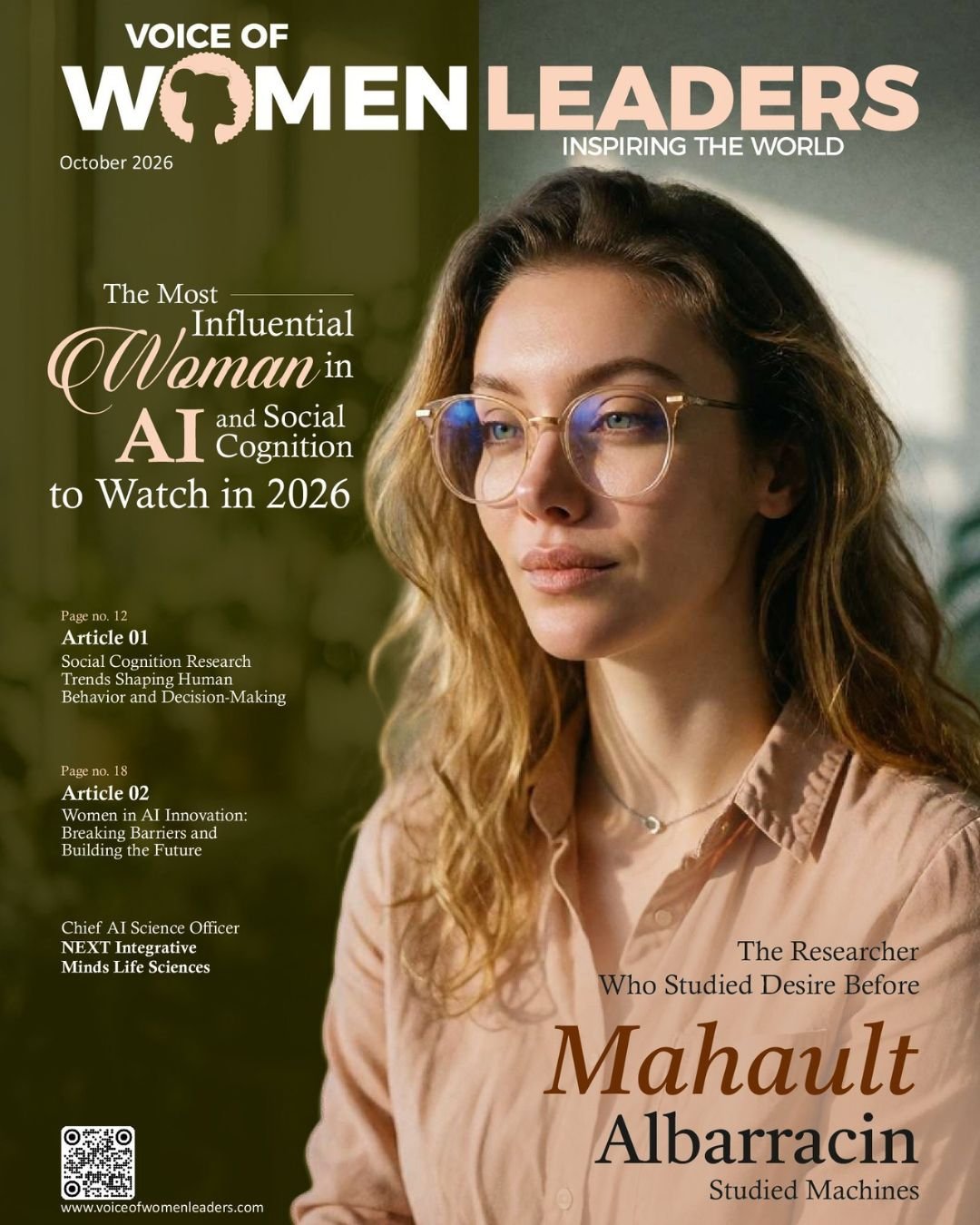
Mahault Albarracin holds a Master’s in Sexology and a PhD in Cognitive Computing, an unlikely pairing that turned out to be exactly the right training for building AI systems that can genuinely model how people think and feel.
As Chief AI Science Officer at NEXT Integrative Minds Life Sciences, she is arguing that empathy in AI has to be modeled, not simulated, and that the difference matters to everyone who interacts with these systems.
Most AI researchers arrive at the field through mathematics, computer science, or engineering. Mahault Albarracin arrived through the study of human desire. Before she was modeling social cognition in artificial agents, she was studying sexology, a discipline built entirely around a stubborn methodological problem: the instrument you’re measuring with, a person’s own account of their experience, cannot be fully trusted, and yet you still have to say something rigorous about it.
That training left her with a habit most technical researchers never develop. Rather than treating behavior as the thing to be explained, she treats a person’s own account of their experience as evidence about the model they’re running internally, not as ground truth, but as data about expectation, prediction, and the gap between what someone anticipated and what they actually got. It’s a distinction she didn’t have language for until she encountered active inference theory years later and recognized, almost immediately, a formalism for an intuition sexology had already taught her.
Today, as Chief AI Science Officer at NEXT Integrative Minds Life Sciences, Albarracin works at the intersection of active inference, empathy modeling, and social cognition, building AI agents that don’t simply produce the outputs of a caring response, but carry an actual representation of another person’s state, one that can be wrong, and can be corrected when it is. That distinction, between simulating empathy and modeling it, sits at the center of nearly everything she builds, and increasingly, at the center of how she believes the entire field needs to evaluate itself over the next five years.
The Iconic Origin — From Sexology to Cognitive Computing
- You hold a Master’s in Sexology and a PhD in Cognitive Computing. What does a deep training in human sexuality and intimacy give you as an AI researcher that a purely technical background never could?
Sexology trains you on a subject where you can’t trust the instrument. People misreport, they reinterpret afterwards, and asking the question changes the answer. You still have to say something rigorous. That’s most of what I do now.
It also left me a habit that a technical training would have taken out of me. I treat people’s own accounts of their experience as data. Not as ground truth, as evidence about what model they’re running. An engineer looks at a behaviour and asks what function produced it. A sexologist asks what the person thought was happening. Those are different questions, and the second one is much closer to what a generative model actually is.
- Most AI researchers come from mathematics, computer science, or engineering. What did studying human desire, attachment, and relational behaviour teach you about how minds actually work?
That minds are not solitary. Attachment is a control loop running between two nervous systems, and it works because each one is partly predictable to the other. You don’t calm yourself down on your own. Someone else does part of it for you.
The other thing is that behaviour on its own means very little. The same act reads as care or as intrusion depending on what the person was expecting. So the object of study is never the behaviour itself, it’s the gap between what someone expected and what they got. I was studying prediction error for years before I had the word for it.
- When did you first see the connection between understanding human sexuality and building machines that genuinely model social cognition and empathy?
I would like to say there was a moment. There wasn’t. I kept finding the same shape in two places.
In sexology, desire isn’t a fixed quantity a person has. It gets configured by context and by who else is in the room. Then I started reading Friston and found people describing exactly that with equations, except they thought they were talking about perception. The claim that you don’t have a state so much as you’re continuously inferring one was already the thing I had been taught about intimacy. The formalism arrived well after the intuition.
The Technical Framework — Active Inference and Social Cognition
- You work on active inference and empathy modelling in artificial agents. What is active inference, and why does it produce more genuinely human-like social behaviour than conventional AI approaches?
Active inference says a system carries a model of its world and acts to keep that model right. Perception updates the model, action changes the world so the model fits. Both are the same operation.
I’m careful with the words human-like though. It doesn’t automatically make behaviour look more human. What it does is force you to state what the system expects and how confident it is, and those two things are what drive social behaviour in people. A system trained only on outputs can reproduce the surface of a conversation without ever being committed to anything. An active inference agent has to hold a position about the world and pay a cost when it turns out to be wrong. That’s the part I care about.
- Most AI systems simulate empathy rather than model it. What is the fundamental difference, and why does that distinction matter for every human who interacts with an AI agent?
A system that simulates empathy produces the outputs. It says what a caring person would say. A system that models it carries a representation of your state, and that representation constrains what it does next.
The difference shows up when the system is wrong. A simulator has no way to notice, because it was never tracking anything. It was producing text that matched a pattern. A model can be wrong in a way it can detect, because it made a prediction about you and you went and did something else.
That’s what matters to anyone using these things. A system that can’t be wrong about you also can’t update about you. It will be confidently warm at you forever.
- Social cognition is one of the hardest problems in AI. What is the specific gap in how the field currently approaches it that your research is working to close?
Most of the field treats social cognition as one agent inferring the state of one other agent. Theory of mind as a two-body problem.
That’s not what people do. We share models, and the model is held up by a group rather than by any individual in it. What I can infer about you depends on norms neither of us invented. My colleagues and I have worked on this as epistemic communities, agents whose beliefs stay cheap to maintain because the people around them hold compatible ones.
The second gap is that accuracy gets treated as the goal. A great deal of social cognition is about making yourself predictable to other people, which is a different problem and sometimes pulls against being accurate about them.
- You work on Partially Observable Markov Decision Processes in social contexts. What does that framework unlock about how agents navigate uncertainty in human interaction?
The partially observable part is the whole point. You never see someone’s state. You see what they did, and whatever produced it stays hidden. A POMDP makes you admit that and then write down what you would do anyway.
What it gives you is that gathering information becomes an action with a cost, like any other action. Asking a question, waiting, testing something gently, those stop sitting outside the model and become policies you can evaluate against each other. In social settings that’s most of what people are doing. Half of any conversation is probing to find out which model of you is the right one.
From Research to Real-World Application
- As Chief AI Science Officer at NEXT Integrative Minds Life Sciences, how does your research in social cognition and empathy modelling translate into real learning science applications?
Learning is a person updating a model, so the signal worth having isn’t whether the answer was right. It’s where the learner’s prediction failed and how confident they were when it failed.
A learner who is wrong and knows it needs something completely different from a learner who is wrong and certain. Confidence isn’t a soft variable in this framework. It’s precision, and it decides whether new information gets in at all. Someone holding high confidence in a wrong model won’t absorb a correction however well you word it. You have to move the confidence first. That’s the piece of my research that’s directly usable in a learning product.
- What does a learning science company gain by embedding genuine empathy modelling into its AI that conventional educational technology simply cannot deliver?
Conventional systems adapt on performance. Performance tells you an answer was wrong. It doesn’t tell you why, and the why is where all the useful branching lives.
Not knowing, knowing and not trusting it, knowing and being checked out, all three produce the same wrong answer and all three need a different response. You only separate them by modelling the learner’s state instead of their score. Most adaptive systems are pattern matching on outcomes and calling it personalisation.
- You bridge industry, academia, and research institutions simultaneously. What breaks when those worlds stay disconnected, and what becomes possible when they do not?
Timelines break first. Academia works on a horizon where you’re allowed to be wrong for two years. Industry needs something inside the quarter. Neither one is being unreasonable, they just can’t hand work to each other directly.
Validation breaks second. Industry ships things that were never tested against a real claim, and academia produces results that hold on a benchmark and never touch a person. When it does work, the company gets a question that’s actually answerable and the lab gets data it could never have collected on its own. Quite a lot of my time goes into translating between the two, and I have stopped treating that as overhead.
Vision, Leadership & the Future of the Field
- As a woman leading foundational AI research at the intersection of cognition, empathy, and human connection, what responsibility comes with that position in a field still dominated by a narrow demographic?
I’m wary of the version where the responsibility is representational. Being visible isn’t the job.
The part I do take seriously is which questions get treated as legitimate. Fields decide what counts as a real research problem, and that decision usually looks technical when it’s not. Empathy, intimacy, social norms, all of these were called soft for a long time, which mostly meant they were considered someone else’s problem. Having a seat where those calls get made means I can insist that a question is real. I think that’s worth more than being an example.
- What is the most important thing the mainstream AI industry still gets fundamentally wrong about modelling human social behaviour?
Treating a good imitation as evidence of a model. A system can reproduce human social output at scale without ever having represented a person, and the field keeps reading fluency as understanding.
The other one is the assumption that there’s a single normal to model. Social behaviour is enormously variable and most of that variance isn’t error. Anything built on an average will treat a person who sits off centre as a deviation to be corrected. I work on operator safety in a separate context and the problem isn’t abstract there. If your baseline is the average person, you will be wrong about the specific one in front of you all day long.
- Where does the field of empathy modelling and social cognition in AI go in the next five years if the right researchers ask the right questions?
I would rather not predict capability. I would predict measurement.
The field can already generate behaviour that looks empathic. What it can’t do is say whether a given system’s model of a person is any good, because we have almost no measures that are not just humans rating the output. If the next five years produce a real way to evaluate that, everything else follows from it. If they don’t, we get more convincing systems and still no way to tell which of them are working.
- To the young woman studying psychology, sexology, or cognitive science who wonders whether her background belongs in AI, what do you want her to know?
That the background isn’t a gap she has to make up for. It’s the reason she will ask a question nobody else in the room is asking.
Go and learn the formal side properly though. Don’t let anyone convince you that being interested in people means the mathematics isn’t for you, and don’t use being interested in people as a reason to avoid the mathematics either. Both of those happen, and I have watched both waste people. The ones who end up doing interesting work here are the ones who kept the question and went and got the tools.