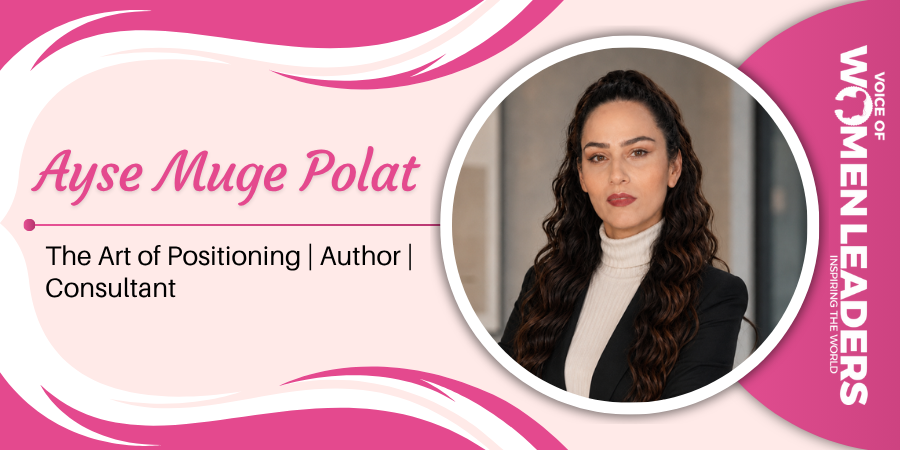
Ayşe Müge Polat: Where Positioning, Human Intelligence, and Business Growth Converge
In a business world increasingly shaped by artificial intelligence, accelerated competition, and constant transformation, Ayşe Müge Polat looks beyond conventional formulas for growth. Her approach begins with a deceptively simple question: What happens to human potential when the environment around it changes?
As a business consultant with expertise spanning Business Consulting, Public Relations, Growth Marketing, Content Strategy, Research, Brand Design, and Brand Marketing, Polat brings together disciplines that are often treated separately. Her work explores the connection between business strategy and the people responsible for bringing that strategy to life.
At the heart of her thinking is Positioning Intelligence—a perspective that views leadership and organizational performance through the lens of human behavior, cognitive capacity, and the conditions leaders create for their teams.
The Hidden Architecture Behind Performance
Why can the same person perform brilliantly under one leader yet hesitate under another?
For Polat, the answer lies beyond knowledge or motivation. People continuously interpret their surroundings. They assess uncertainty, status, trust, control, and the consequences of making mistakes. Those signals can influence whether an individual approaches a challenge with curiosity or caution.
This observation challenges an old management assumption: that performance can simply be increased by applying more motivation.
A more meaningful question is: What kind of environment allows people to think at their highest level?
When leaders create unnecessary uncertainty or make every mistake feel dangerous, they may unintentionally restrict creativity and independent thinking. Conversely, when expectations are clear and people understand that thoughtful disagreement is acceptable, teams can devote more energy to solving problems rather than protecting themselves.
For Polat, leadership therefore becomes more than directing people. It becomes the design of an environment in which people can contribute fully.
Positioning Intelligence in Practice
Polat’s understanding of positioning extends beyond how a company presents itself to the marketplace. It also considers how people understand their place within an organization.
A strong external brand can attract attention, but sustainable growth requires internal alignment. Employees need to understand the organization’s direction, customers need to recognize its value, and leadership needs to ensure that communication matches reality.
Her multidisciplinary background allows her to approach this alignment from several angles.
Research reveals what audiences and markets actually need. Growth marketing turns insight into opportunity. Content strategy gives ideas clarity and consistency. Public relations builds credibility and relationships. Brand design and marketing transform positioning into an identity that people can recognize.
Rather than viewing these functions as separate services, Polat sees them as parts of a larger business ecosystem.
When strategy and communication reinforce one another, a company becomes easier to understand and easier to trust.
From Leadership Style to Cognitive Environment
Different leadership approaches can create different working conditions.
Transformational leadership provides meaning. A compelling vision can give employees a framework for navigating uncertainty and understanding how their contribution connects to a larger objective.
Transactional leadership provides predictability. Clear responsibilities, expectations, and processes can reduce unnecessary ambiguity and allow people to focus on execution.
Servant leadership can reduce defensiveness by making authority a source of support rather than intimidation. Authentic and ethical leadership adds consistency, showing people through repeated actions which values genuinely guide the organization.
The underlying lesson is powerful: culture is not created by slogans. It is created by patterns of behavior.
What happens when someone challenges a senior leader? How is a mistake handled? Who receives credit? What happens when inconvenient information reaches the executive table?
These everyday moments teach employees what the organization truly values.
Nervous System Leadership in the Age of AI
Artificial intelligence is rapidly expanding the amount of information businesses can process. Algorithms can identify patterns, generate options, analyze data, and accelerate decision-making.
But Polat believes the rise of AI makes human judgment more important—not less.
The difficult questions are rarely limited to what technology can recommend. Leaders must also ask: Should we trust the recommendation? What might be missing? What are the consequences? Who is responsible for the outcome?
This thinking forms the foundation of what Polat calls Nervous System Leadership.
The leader becomes an architect of the organization’s psychological and cognitive conditions. Every reaction communicates something. A dismissive response to dissent can discourage future ideas. A thoughtful response to failure can turn an uncomfortable experience into learning.
In this sense, leadership becomes a behavioral prediction system. People learn what is safe to say, what is rewarded, and what is discouraged by watching what happens around them.
The Difference Between Pressure and Threat
Polat does not advocate a workplace without challenge. High performance requires ambition, accountability, and constructive friction.
The important distinction is between productive pressure and unnecessary threat.
“Can we execute this better?” opens the door to improvement.
“Do not question my decision” closes it.
The first challenges the work. The second challenges the person’s permission to think.
For organizations navigating rapid change, that distinction can have significant consequences. Innovation requires people who are willing to question assumptions, identify weaknesses, and propose alternatives. If employees learn that disagreement carries an unacceptable personal cost, organizations eventually lose access to some of their most valuable thinking.
Consulting Beyond the Conventional
Polat’s consulting philosophy reflects a broader shift in what businesses increasingly need from external advisors.
The modern consultant cannot simply provide a strategy document and walk away. Organizations need clarity about how strategy connects with positioning, communication, growth, culture, and human behavior.
That is where Polat’s multidisciplinary perspective becomes particularly relevant.
She approaches business challenges as connected problems rather than isolated functions. A weak marketing result may originate in unclear positioning. A brand problem may reflect inconsistent internal behavior. A growth challenge may require a deeper understanding of audience expectations rather than another campaign.
The consultant’s role becomes one of diagnosis, alignment, and clarity.
Building Businesses That Think Better
As businesses move deeper into the AI era, access to information will become less of a differentiator. What matters increasingly is what organizations do with that information.
The winners will need more than technology. They will need judgment. They will need leaders capable of balancing accountability with psychological safety, innovation with structure, and commercial ambition with human understanding.
This is where Ayşe Müge Polat’s perspective becomes especially relevant.
Her work suggests that the future of business consulting is not simply about helping organizations move faster. It is about helping them think more clearly, position themselves intelligently, communicate with purpose, and create conditions in which people can perform at their best.
In an age where technology can increasingly replicate execution, human judgment becomes more valuable.
And perhaps that is the most enduring idea behind Polat’s philosophy: leadership is not only about deciding what an organization should do. It is about creating the conditions that allow the people within it to think, contribute, and grow.