Ursula von der Leyen Green Deal: €28 Billion Green Industrial Investment Announced
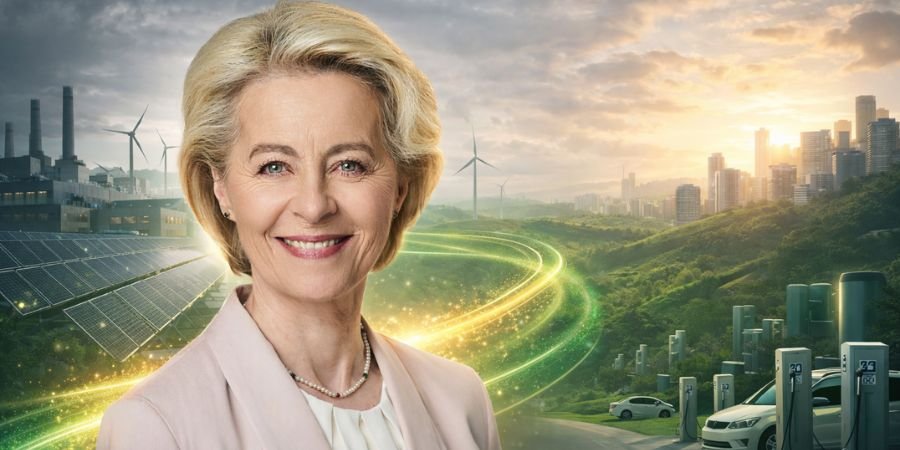
Ursula von der Leyen has announced a sweeping €28 billion “Green Industrial” investment package aimed at strengthening Europe’s clean manufacturing capacity and accelerating its path toward climate neutrality.
The announcement, made at the European Commission headquarters in Brussels, outlines funding designed to support renewable energy production, battery manufacturing, hydrogen infrastructure, and next-generation clean technologies.
According to the European Commission, the initiative is part of a broader strategy to enhance Europe’s industrial competitiveness while reducing reliance on external supply chains.
Strategic Expansion of the Ursula von der Leyen Green Deal
The €28 billion investment builds directly on the framework of the Ursula von der Leyen Green Deal, reinforcing the European Union’s legally binding target of becoming the world’s first climate-neutral continent by 2050.
Commission officials stated that the funding will prioritize domestic manufacturing of solar panels, wind turbines, heat pumps, and advanced battery systems. The plan also includes incentives for private-sector co-investment and streamlined regulatory approvals for green projects.
In her remarks, von der Leyen emphasized that climate policy and industrial growth must move in tandem. She described the initiative as both “an environmental necessity and an economic opportunity.”
Strengthening Europe’s Competitive Edge
The investment comes amid increasing global competition in clean technology, particularly from the United States and Asia. Policymakers have expressed concern over supply chain vulnerabilities exposed in recent years.
By scaling up local production, EU leaders aim to safeguard strategic industries while creating new jobs in high-tech manufacturing sectors. The Commission estimates the initiative could mobilize significantly more private capital over the coming decade.
Business and technology analysts note that the funding signals Europe’s intent to remain competitive in the global race for green innovation.
Market and Industry Reaction
Initial reactions from industry groups and sustainability advocates have been largely positive. Manufacturing associations welcomed the financial backing but called for clear implementation timelines.
Financial markets responded cautiously, with renewable energy and clean-tech stocks showing moderate gains following the announcement. Analysts suggest long-term impacts will depend on regulatory clarity and member-state coordination.
Policy Context and Long-Term Vision
The Ursula von der Leyen Green Deal was first introduced in 2019 as a comprehensive roadmap for transforming Europe’s economy. It covers emissions reduction, energy transition, circular economy policies, and biodiversity protection.
The newly announced Green Industrial investment strengthens the Deal’s industrial pillar, reflecting a growing consensus that climate ambition must be supported by production capacity within Europe.
Commission officials indicated that additional policy measures may follow later this year, including incentives for small and medium-sized enterprises and further reforms to state aid rules.
What Comes Next
The proposal now moves toward approval and coordination with EU member states. Funding allocations are expected to roll out in phases beginning later in 2026.
Observers say the scale and execution of the package will determine whether Europe can secure its position as a leader in sustainable industry.
If implemented effectively, the initiative could mark a decisive step toward achieving the EU’s 2050 climate neutrality target while reshaping the continent’s industrial landscape for decades to come.