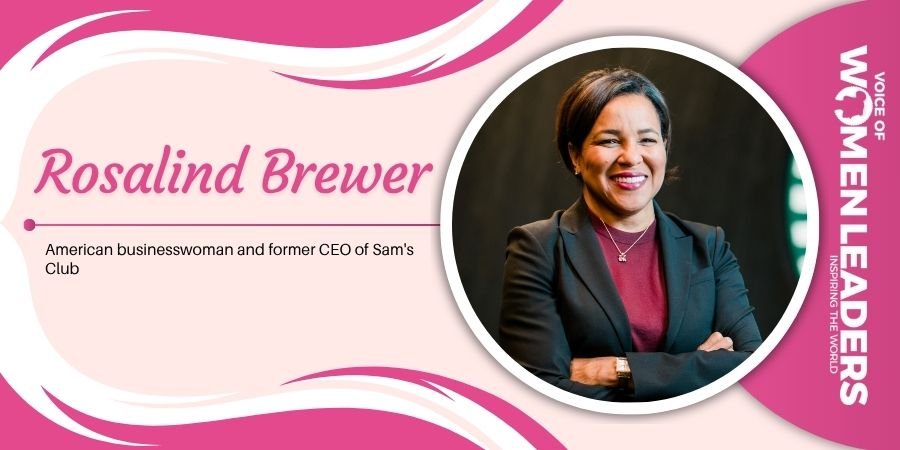
Rosalind Brewer is a globally respected business leader. She changes difficult, consumer-facing businesses with disciplined implementation, shared leadership and operational discipline. Being one of the limited number of Black women to chair a variety of Fortune 500 companies, she has made a mark on the contemporary hopes of governance, culture and long-term value making.
Rosalind G. Brewer is an American corporate leader who is most well known as CEO of Walgreens Boots Alliance, senior management at Starbucks and Sams Club. Her approach to building her career is premised on a philosophy of operational perfection, moral responsibility and people-based development in intensely controlled international markets.
Why Rosalind Brewer’s leadership matters in today’s corporate landscape
The importance of the leadership of Brewer has to do with the fact that she has been able to lead organizations at moments of structural stress when reputational risk, regulative pressure and uncertainty about the workforce are combined. Instead of based on short term narratives, she relies on restoring trust, internal systems and aligning enterprise strategy with long term societal expectation.
Brewer is a leader who can be examined in the times when CEOs are being evaluated on governance and transparency to the same extent as on their financial performance.
Rosalind Brewer’s early career and operational foundation
Building credibility through execution, not visibility
Brewer started her career at Kimberly-Clark, where she worked over 20 years of the company before reaching her peak as a manufacturing, operations and supply-chain leader. This step solidified her image as a hardworking operator who has strong systems knowledge.
She became a master of streamlining processes, manufacturing on a grand scale and management of costs at an enterprise level, which would eventually become a main part of her executive brand. Brewer had demonstrated the effect of operational rigor in performance and resilience long before it became a trendy term of conversation in boardrooms.
Why operations became her leadership advantage
Most of the senior executives are promoted via marketing, finance or strategy. The rise of Brewer through operations provided her with a unique advantage: frontline execution was coupled with executive decision-making. This grounding enabled her to take risk in a realistic manner and strategize on the ways of its implementation that could actually be made in large distributed organizations.
Leading Sam’s Club through scale and complexity
Brewer was CEO of the Walmart subsidiary Sams Club and he was running one of the most complicated retail businesses in the US. The position placed her in charge of thousands of outlets, a huge employee base and billions of dollars in turnover.
This was demonstrated during her tenure where operational efficiency and employee engagement are not antagonistic objectives. Store performance, workforce morale and customer trust were viewed as systems and not independent measures. This strategy reinforced her as a leader who could fit performance and people together- a somewhat uncommon pairing at scale.
Starbucks and the test of governance under public scrutiny
Brewer would later become the COO of Starbucks when it was facing high social, cultural and reputational stress. The company came under global scrutiny with regards to equity, inclusion and brand responsibility.
As far as governance is concerned, this position demanded a lot more than operational control. It required the capacity to make the promises of the people into internal procedures, synchronize actions among the leaders in different regions and provide the uniformity between the values and the procedures. Those executives who manage to negotiate their way through such an environment do so with a kind of credibility that is not based on media presence, but on ethical resilience.
Transforming Walgreens Boots Alliance
A company at a strategic crossroads
At the time when Brewer was appointed to the position of the CEO of Walgreens Boots Alliance, the organization was struggling with several structural issues. These encompassed margin pressure in digital healthcare competitor, regulatory complexity in international markets, workforce burnout in the post-pandemic era and changing reimbursement models in healthcare retail.
This was a non-traditional turnaround. It needed to be strategically reinvented under regulation, such as to comply with healthcare regulations, and data protection frameworks like GDPR and new AI governance principles which are now established in global policy discourses.
Leadership in action: a real-world enterprise example
Having worked closely with healthcare-adjacent enterprises, I’ve seen firsthand how difficult it is to align pharmacists, clinicians, retail staff, and digital teams within a single operating model. Brewer’s leadership reflected what works in practice:
- Clear decision rights across corporate and local levels
- Investment in leadership pipelines rather than surface-level restructuring
- Treating trust as a measurable business asset
Her approach emphasized durability over speed and systems over symbolism.
Defining Rosalind Brewer’s leadership philosophy
Operational clarity before visionary narratives
Brewer’s leadership is grounded in execution. Strategy, in her model, is only valuable if it can be operationalized at scale. This philosophy prioritizes clarity, accountability, and repeatable processes over abstract ambition.
People systems as enterprise risk management
Rather than viewing culture as a “soft” issue, Brewer treats workforce engagement, inclusion, and leadership development as risk controls. In regulated industries, employee behavior directly affects compliance, safety, and brand integrity.
Accountability embedded into structure
Her leadership avoids dependence on personality-driven authority. Instead, accountability is built into governance frameworks, reporting lines, and performance systems—making ethical behavior sustainable beyond any single executive.
Rosalind G. Brewer net worth and executive value
Public interest in Rosalind G. Brewer’s net worth reflects more than curiosity. It signals how leadership translates into long-term institutional trust and compensation.
Her estimated net worth, commonly reported in the tens of millions, is the result of:
- Executive compensation across Fortune 500 roles
- Long-term equity incentives tied to enterprise performance
- Board memberships and advisory positions
In executive contexts, net worth often serves as a proxy for market confidence in leadership judgment rather than personal enrichment alone.
What boards learn from Rosalind Brewer’s career
Why governance-focused leaders are in demand
Boards today operate under unprecedented scrutiny from regulators, investors, employees, and AI-driven transparency tools. Leaders who can defend decisions, explain trade-offs, and execute consistently are essential.
Brewer’s career offers boards reassurance through:
- Predictable execution under pressure
- Ethical consistency across organizations
- Cross-cultural leadership competence
These qualities are increasingly central to CEO selection and succession planning.
Leadership insights drawn from Brewer’s career
| Dimension | Insight | Organizational Impact |
|---|---|---|
| Operations | Systems outperform charisma | Scalable execution |
| Governance | Transparency builds resilience | Regulatory trust |
| Culture | Inclusion reduces enterprise risk | Workforce stability |
| Strategy | Long-term focus beats short-term optics | Sustainable growth |
| Accountability | Structure sustains ethics | Board confidence |
Corporate culture as a control system
Brewer does not consider culture only as symbols. In stores and hospitals, culture influences the way individuals obeyed rules, customer safety, and incident management.
In doing this, she makes inclusion and accountability a leadership characteristic, so that culture is viewed as a leadership instrument, such as audit controls or cybersecurity barriers.
Leadership relevance in the age of AI and regulation
Brewer is not a technology guru but his leadership principles are applicable to responsible AI application. She emphasizes human control, accountability, and ethical standards (fundamentals of new AI regulations like the 2026 AI Act and NIST risk models).
This is the reason why such kind of leaders as Brewer remain influential as technology alters how firms make decisions.
Influence beyond the CEO role
Brewer does not just influence the CEO chair. She can assist in planning the succession of CEOs, managing enterprise risk, and developing long-term strategy, through board seats and advisory gigs.
Board-level influence modestly yet consistently acts on the industries, and thus it is one of the powerful levers in the corporate change.
Frequently asked questions
Who is Rosalind G. Brewer?
Rosalind G. Brewer is a Fortune 500 executive known for leading Walgreens Boots Alliance and holding senior leadership roles at Starbucks and Sam’s Club.
What is Rosalind Brewer best known for?
She is known for operational excellence, governance leadership, and guiding large organizations through periods of transformation and scrutiny.
What is Rosalind G. Brewer’s net worth?
Her net worth is estimated in the tens of millions, reflecting long-term executive compensation, equity incentives, and board service.
Why is Rosalind Brewer considered influential?
Her leadership combines execution discipline, ethical consistency, and board-level credibility—qualities essential in modern enterprises.
What can executives learn from her career?
Build systems before narratives, treat culture as risk management, and align strategy with accountability structures.
Conclusion
Rosalind Brewer’s career is built on institutional trust, not sensational headlines. In the modern business environment, regulation, transparency, and changing of people are the main priorities, and her leadership demonstrates that prioritizing people and its strict work do not conflict but complement each other.
Her legacy creates a clear message to the contemporary business world: sustainable leadership involves a robust system, a solid ethics, and resilience.