The moment you step out after styling your hair and notice your curls behaving completely differently than expected, you realize something important—curly hair isn’t just “curly.” Some strands spiral tightly, others form loose waves, and a few seem to change personality depending on the weather. Understanding curl types becomes more than a curiosity; it turns into the key to managing, styling, and actually loving your hair. Without knowing the different types of curly hair, it’s easy to use the wrong products, follow the wrong routines, and end up frustrated. But once you crack the code behind hair curl types, everything starts making sense—from frizz control to defining those perfect curls.
What Are Curl Types and Why They Matter
Understanding curl types is the foundation of any effective hair care routine. It’s not just about appearance; it determines how your hair reacts to humidity, products, and styling techniques.
Hair experts categorize types of curls into patterns based on shape, texture, and thickness. These categories help you identify exactly what your hair needs rather than relying on generic advice.
When you know your curly hair types, you can:
- Choose the right products
- Avoid unnecessary damage
- Improve curl definition
- Reduce frizz and dryness
- Create styles that actually last
Ignoring your hair’s natural pattern often leads to frustration. Embracing your specific types of curly hair allows you to work with your hair instead of against it.
The Main Categories of Curl Types
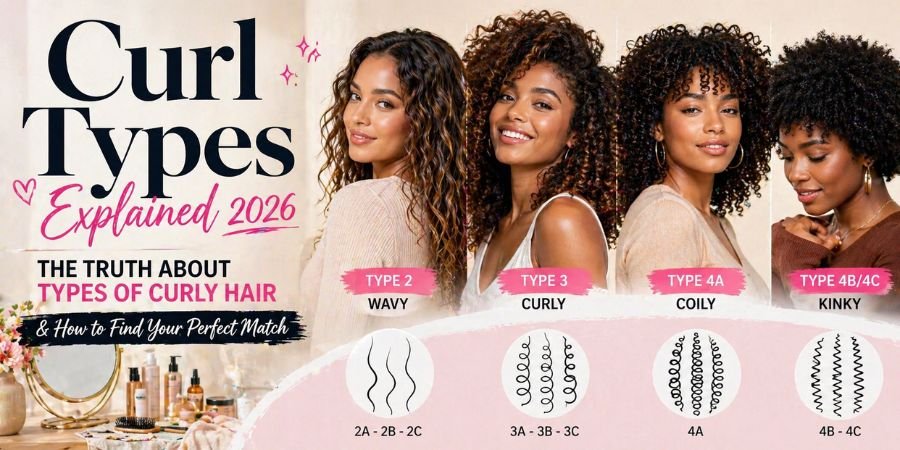
Hair curl types are commonly divided into four major categories:
1. Type 1 – Straight Hair
Although not technically curly, this category is important for comparison.
- No visible curl pattern
- Tends to get oily quickly
- Lacks volume
This type helps define the starting point before moving into actual types of curls.
2. Type 2 – Wavy Hair
This is where curls begin to form, though loosely.
Type 2A
- Slight bend
- Soft texture
- Minimal frizz
Type 2B
- More defined waves
- Some frizz
- Medium thickness
Type 2C
- Strong wave pattern
- Almost curly
- Prone to frizz
Wavy hair often sits between straight and curly, making it tricky to manage. Many people with this curly hair type struggle to find the right balance between hydration and volume.
3. Type 3 – Curly Hair
This is what most people think of when discussing curl types.
Type 3A
- Loose, large curls
- Shiny appearance
- Easy to style
Type 3B
- Tighter curls
- More volume
- Prone to dryness
Type 3C
- Corkscrew curls
- Dense texture
- Needs heavy moisture
These types of curly hair are highly versatile but require consistent care to maintain definition and prevent frizz.
4. Type 4 – Coily/Kinky Hair
The tightest and most delicate of all hair curl types.
Type 4A
- Soft coils
- Defined pattern
- Retains moisture better
Type 4B
- Zig-zag pattern
- Less definition
- Highly fragile
Type 4C
- Very tight coils
- Minimal visible pattern
- Maximum shrinkage
These types of curls require deep hydration, gentle handling, and protective styling to stay healthy.
How to Identify Your Curl Type
Figuring out your exact curl type isn’t always straightforward. Hair can have multiple patterns on different parts of the head.
Here’s how to determine your types of curly hair:
1. Observe Your Hair When Wet
Water reveals your natural pattern better than dry hair.
2. Avoid Products Initially
Let your hair dry naturally without creams or gels.
3. Check Curl Shape
Look closely at whether your hair forms waves, spirals, or tight coils.
4. Analyze Thickness
Hair strand thickness also plays a role in how hair curl types behave.
Factors That Affect Curl Types
Even within the same category, your types of curls can behave differently due to several factors.
1. Porosity
- High porosity absorbs moisture quickly but loses it fast
- Low porosity resists moisture
2. Density
- How many strands you have
- Affects volume and styling
3. Elasticity
- Determines how well your curls bounce back
These elements work alongside your curly hair types to define how your hair behaves daily.
Best Hair Care Routine for Different Curl Types
For Wavy Hair (Type 2)
- Use lightweight products
- Avoid heavy oils
- Scrunch for definition
For Curly Hair (Type 3)
- Hydrating shampoos
- Leave-in conditioners
- Curl creams for definition
For Coily Hair (Type 4)
- Deep conditioning weekly
- Protective styles
- Minimal heat usage
Tailoring your routine to your specific types of curly hair ensures better results and healthier strands.
Common Mistakes People Make with Curl Types
Many people unknowingly damage their hair by misunderstanding curl types.
1. Using the Wrong Products
Heavy creams on wavy hair or light sprays on coily hair rarely work.
2. Overwashing
Curly hair tends to be dry, so frequent washing strips natural oils.
3. Skipping Moisture
All types of curls need hydration, just in different amounts.
4. Brushing Dry Hair
This disrupts the curl pattern and causes frizz.
Styling Tips Based on Curl Types
Enhancing Waves
- Use sea salt sprays
- Air dry when possible
Defining Curls
- Apply products on damp hair
- Use the “praying hands” method
Managing Coils
- Section your hair
- Use protective styles like braids
Styling becomes much easier when you understand your hair curl types.
How Weather Affects Curly Hair Types
Humidity is one of the biggest challenges for all types of curly hair.
- High humidity causes frizz
- Dry weather leads to breakage
Adjusting your routine based on climate can significantly improve how your curl types behave.
Products That Work Best for Different Curl Types
Choosing the right products is essential for maintaining healthy curly hair types.
For Type 2
- Lightweight mousse
- Texturizing sprays
For Type 3
- Curl creams
- Hydrating gels
For Type 4
- Butters and oils
- Deep conditioners
Matching products with your types of curls makes styling more effective and long-lasting.
The Psychology of Embracing Your Curl Type
There’s a deeper layer to understanding curl types—acceptance.
For years, many people tried to straighten or alter their natural hair texture. But recognizing your types of curly hair helps build confidence and simplifies your routine.
Your hair doesn’t need to be “fixed.” It needs to be understood.
FAQs
1. Why are there different curl types?
Hair structure is determined by genetics, which affects follicle shape and growth pattern, resulting in different types of curls.
2. How can I change my curl type permanently?
You can’t naturally change your curly hair types, but chemical treatments or heat styling can temporarily alter them.
3. When should I wash curly hair?
Most types of curly hair benefit from washing 2–3 times per week to maintain moisture balance.
4. Where can I find products for my curl type?
You can find products online or in stores that specifically label compatibility with different hair curl types.
5. How long does it take to understand your curl type?
It may take a few weeks of observation and experimentation to fully understand your types of curls.
Conclusion
Once you truly understand your curl types, everything about hair care becomes simpler and more intentional. The confusion fades, and in its place comes clarity—about what works, what doesn’t, and why your hair behaves the way it does. Instead of chasing trends or copying routines, you begin to build a system tailored specifically to your types of curly hair. That shift changes not just how your hair looks, but how you feel about it. Spend time observing your curls, experiment with care, and let your natural texture guide you toward the results you’ve been looking for.
Also Read: Lash Extensions: Your Ultimate Guide to Stunning, Long-Lasting Lashes